nvim-pi
Bidirectional communication between Neovim and Pi.
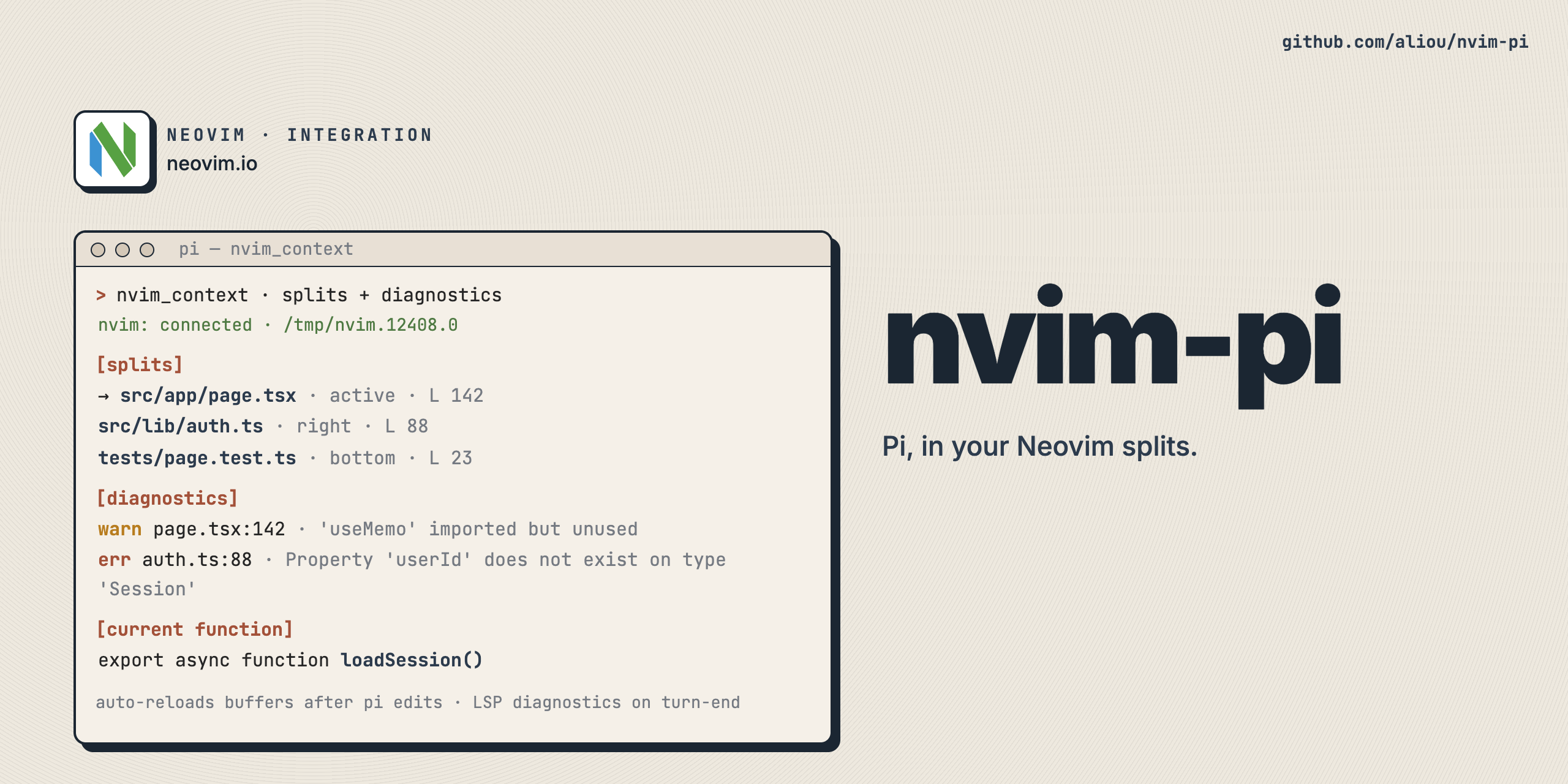
@aliou/nvim-pi
Neovim plugin with a bundled Pi extension.
This package works in two modes:
- install it as a Neovim plugin and let it launch Pi with the bundled extension
- install it with
pi install git:github.com/aliou/nvim-piand use the extension directly in terminal Pi sessions
When Neovim is not running, the extension still loads cleanly and degrades gracefully.
What it provides
Pi extension
| Tool / Command | Description |
|---|---|
nvim_context | Query the connected Neovim instance for focused buffer, splits, diagnostics, or current function |
/neovim:settings | Configure Neovim integration settings for the Pi extension |
/neovim:undotree [file] | Inspect a Neovim persistent undo tree for a file |
@vim: autocomplete | Type @vim: in Pi’s input to autocomplete file paths from visible Neovim splits |
Additional disabled-by-default behavior:
extensions/undocan update matching Neovim persistent undo files after successful Pieditandwritetool calls.
Behavior provided by hooks:
- automatically discovers and connects to a matching Neovim instance on session start
- injects visible editor state into the system prompt on each turn (configurable)
- reloads files in Neovim after successful
writeandedittool calls - sends LSP diagnostics for modified files after the turn ends
Neovim plugin
- starts a Neovim RPC server and writes lockfiles Pi can discover
- opens Pi in a terminal split or float
- passes through selected Pi CLI flags
- runs a periodic
checktimetimer while Pi is open to detect external file changes - provides a context picker (
<C-Space>by default) to send editor context to Pi - exposes
:PiNvimStatus
Setup
As a Neovim plugin
Install this repo as a Neovim plugin. The lua/ directory is runtimepath-compatible.
Example with vim.pack:
vim.pack.add({ { name = "nvim-pi", src = "https://github.com/aliou/nvim-pi" } })
require("pi-nvim").setup()
Use an existing Pi git install as a Neovim plugin:
pi install git:github.com/aliou/nvim-pivim.opt.runtimepath:append(vim.fn.expand("~/.pi/agent/git/github.com/aliou/nvim-pi"))
require("pi-nvim").setup()If you installed it into project settings with pi install -l, use that project’s .pi/git/github.com/aliou/nvim-pi path instead.
Local checkout setup for development:
vim.opt.runtimepath:append(vim.fn.expand("/absolute/path/to/nvim-pi"))
require("pi-nvim").setup()
Requirements:
pimust be onPATHnvimmust supportserverstart()and--remote-expr
When you open Pi through pi-nvim, the plugin launches:
pi --extension /absolute/path/to/nvim-piThe extension then injects runtime editor state through hooks. By default (load_extension = "auto"), the plugin checks whether nvim-pi is installed globally in Pi and skips --extension if so — this avoids loading the extension twice when you already installed it with pi install.
As a Pi extension
You can also install it directly in Pi:
pi install git:github.com/aliou/nvim-piThis is useful if you want the extension available in terminal Pi sessions too. If no Neovim instance is running, the extension still loads and simply reports that no instance was found when needed.
Configuration
Pi extension config
/neovim:settings currently exposes:
| Setting | Default | Description |
|---|---|---|
Connection status messages | on | Show nvim: connected / no instance found style messages in the Pi session |
Editor state injection | off | Inject current Neovim editor state (open splits, cursor position) into each prompt automatically |
@vim: autocomplete | enabled | Enable autocomplete for open Neovim splits |
Persistent undo tools | disabled | Update Neovim persistent undo files after successful Pi edit and write tool calls |
Feature toggles are shown as unavailable if Pi did not load that extension entry point.
Neovim plugin config
require("pi-nvim").setup({
  auto_start = true,
  data_dir = nil,

  -- Pi CLI flags
  models = nil,
  provider = nil,
  model = nil,
  thinking = nil,
  load_extension = "auto", -- "auto": skip --extension if installed globally; true: always pass; false: never pass
  extra_args = nil,

  -- Window configuration
  win = {
    layout = "auto",
    width_threshold = 150,
    width = 80,
    height = 20,
    focus_source_on_stopinsert = true, -- switch to source window on exiting terminal mode
    keys = {
      close = { "<C-q>", mode = "n", desc = "Close Pi" },
      stopinsert = { "<C-q>", mode = "t", desc = "Exit terminal mode" },
      suspend = { "<C-z>", mode = "t", desc = "Suspend Neovim" },
      picker = { "<C-Space>", mode = "t", desc = "Open context picker" },
    },
  },
})
Keymaps
The plugin does not create global leader mappings by default.
Example mappings:
vim.keymap.set("n", "<leader>po", require("pi-nvim").open, { desc = "Open Pi" })
vim.keymap.set("n", "<leader>pc", require("pi-nvim").close, { desc = "Close Pi" })
vim.keymap.set("n", "<leader>pp", require("pi-nvim").toggle, { desc = "Toggle Pi" })
Terminal/window-local keys are configured under setup({ win = { keys = ... } }).
Usage
From Pi
The nvim_context tool supports these actions:
focused_buffer- focused file, cursor position, selection, filetypesplits- all visible splits with metadatadiagnostics- diagnostics for the current buffercurrent_function- treesitter info for the symbol at the cursor
If multiple matching Neovim instances are found, Pi prompts you to choose one when UI is available.
From Neovim
Commands and API:
:PiNvimStatus- show RPC and terminal staterequire("pi-nvim").open()- open the Pi terminalrequire("pi-nvim").close()- close the Pi terminalrequire("pi-nvim").toggle()- toggle the Pi terminalrequire("pi-nvim").start()- start the RPC server manuallyrequire("pi-nvim").stop()- stop the RPC server manuallyrequire("pi-nvim").status()- get the current RPC staterequire("pi-nvim").is_open()- check if the Pi terminal is open
Pi extension commands:
/neovim:settings- configure connection messages,@vim:autocomplete, and persistent undo integration/neovim:undotree [file]- open a persistent undo tree overlay for a file; when no file is provided, Pi shows a picker if UI is available
Troubleshooting
Pi cannot find Neovim
Check:
:PiNvimStatusshows the RPC server as runningpiandnvimare both onPATH- lockfiles exist under Neovim’s data dir, usually
~/.local/share/nvim/pi-nvim/
Discovery prefers:
- exact cwd matches
- Neovim instances whose cwd is a child of Pi’s cwd
Multiple Neovim instances found
Pi will prompt for selection in interactive mode. In non-interactive mode, the tool returns an error instead of guessing.
RPC server errors
Check:
<stdpath('log')>/pi-nvim/rpc.log(typically~/.local/state/nvim/pi-nvim/rpc.log):PiNvimStatus
Healthcheck
:checkhealth pi-nvimArchitecture
Neovim plugin (Lua)                            Pi extension (TypeScript)
-------------------                            ------------------------
require("pi-nvim").setup()                    pi --extension /path/to/nvim-pi
          |                                                   |
          v                                                   v
   rpc.start()                                     extensions/nvim/index.ts registers:
   lockfile.create()                               - hooks (editor state, lifecycle)
          |                                      - tool (nvim_context)
          v                                      - command (/neovim:settings)
~/.local/share/nvim/pi-nvim/                       - renderers (connection, diagnostics)
<cwd-hash>-<pid>.json                                           |
          |                                          session_start discovers lockfile
          |                                          before_agent_start queries splits
          |                                          tool_result reloads files
          |                                          turn_end requests diagnostics
          v                                                   |
   nvim --server <socket> --remote-expr <luaeval(...)> <------+

Core (src/) has zero Pi dependencies:
  nvim.ts          lockfile discovery + RPC
  types.ts         domain types + type guards
  format.ts        shared formatting helpers

Additional extensions:
  splits-autocomplete/       @vim: autocomplete for open splits
  undo/                       /neovim:undotree plus disabled-by-default persistent undo update hooks

Additional Lua features:
  cli/terminal     open/close/toggle Pi in a split or float
  cli/picker       <C-Space> context picker to send info to Pi
  cli/watch        periodic checktime timer while Pi is open
The TypeScript extension discovers Neovim instances through lockfiles, then queries the running editor through nvim --remote-expr, which evaluates require("pi-nvim").query(...) inside Neovim.